Multi-Channel Enrollment Marketing Program
A 3-month, multi-channel campaign driving Spring 2025 course enrollment across email, SMS, social media, blog content, university-specific landing pages, event funnels, print collateral, and an organic ambassador program — built end-to-end in HubSpot with full UTM attribution.
Program Overview
This program supported enrollment for CodePath’s Spring 2025 course cohort across four technical tracks: Web Development, Cybersecurity, iOS Development, and Technical Interview Prep at six university partner campuses. CodePath offers free, industry-backed courses to college students — meaning the conversion challenge was behavioral, not financial. The work was awareness, motivation, and application completion.
I owned the full marketing lifecycle: campaign strategy, audience segmentation, copy, email and SMS design, blog content integration, university-specific landing pages, event registration funnels, and UTM attribution architecture. One brain from campaign concept through HubSpot deployment — no handoffs.
On the execution side, that meant writing the majority of campaign copy myself (using a copy vendor for overflow during peak periods), designing creative assets in Canva or leading creative direction with a vendor design team, building all HubSpot workflows including automated email sequences, enrollment triggers, and event follow-up campaigns, creating and managing campaign contact lists with segmentation and exclusion logic, organizing the full asset library within HubSpot, and configuring UTM parameters across every touchpoint for attribution reporting.
The conversion challenge was behavioral, not financial. Courses are free. The work was getting a college student with seventeen tabs open to stop scrolling long enough to believe this was worth their time.
Lead with the reader’s specific anxiety at each funnel stage — not the organization’s goals.
The strategic principle behind every touchpoint in this program — from the first info session email to the final deadline SMS.
Channel Architecture
The program operated across nine channels and infrastructure layers, each serving a distinct function in the enrollment funnel. All were connected through a unified UTM framework tracking attribution from first touch through application completion.
Email Campaign Sequence (Sample)
The 12-email sequence followed an awareness → nurture → action → urgency arc over the enrollment window. The core principle: lead with the reader’s specific anxiety at each funnel stage, not the organization’s goals. The audience is a college student with seventeen tabs open — short copy throughout.
I wrote the copy for each email, designed the templates and header graphics in Canva, and built the full campaign infrastructure in HubSpot: automated sequences with enrollment triggers and branching logic, segmented contact lists by university partner and course track interest, and exclusion lists to suppress contacts who had already applied or been admitted — preventing the “why are you still emailing me?” friction that kills brand trust with a student audience.
Every send was an optimization opportunity. I ran A/B tests across four dimensions: subject line testing (tone, length, emoji vs. no emoji), body copy testing (long-form vs. short, single CTA vs. dual CTA), creative and asset testing (header image variants, button color and placement), and send day/time testing to identify when students were most likely to engage. Winning variants informed subsequent sends — the sequence got smarter as it ran.
Below are four emails that illustrate the strategic progression. Click any email to read the full copy.


Spring 2025 Courses Info Session: Register Now!
Low-commitment entry point. The ask is Register, not Apply — reducing friction for prospects who aren’t ready to commit but are willing to explore. Lets them meet staff, see syllabi, and ask questions on their terms.
Hi [First Name],
You’re invited — Join one of our upcoming info sessions to learn more about our industry-backed programs. Our next event is Tuesday, January 14th 2025 from 2–3pm PT.
During the info session, you’ll get to meet CodePath staff, learn more about the syllabi, and connect with other potential classmates.
We’ll have open Q&A time so come prepared with any questions you may have about Spring 2025 courses.
Register Here
See you soon!
CodePath Admissions
📱 (888) 572-8829 (Text only)
✉️ [email protected]
CodePath Courses: It’s the People You Meet
Shifted the value proposition from coursework to community and outcomes. Answers the real question: “is this worth my time?” Peer collaboration, mentorship, Slack community, student testimonial. Dual CTA structure — Course Info for information-seekers, Apply Now for action-takers.
Hello [First Name],
You’ve heard the expression that it’s not what you know but who you know, right? In CodePath courses, you learn lots of the “what” that will level up your skills, but you also roll up your sleeves with peers who can help support you through the course and beyond.
You’ll jump into challenging projects with other dedicated students who help each other learn, make the work fun, and get to know each other by tackling interesting problems together.
Course Info
It’s not just other students, though. CodePath instructors, Tech Fellows (who are more advanced student volunteers), and guest speakers can be instrumental in helping you chart a path to your career in software engineering. Beyond the classroom, CodePath students join a Slack community of students and alumni.
You can also attend extra workshops and special events where you will meet diverse tech professionals with insights into everything from where the industry is heading to presenting your portfolio. Plus, you can sign up for a CodePath mentor, who can meet with you to discuss your goals, listen to your current hurdles, and help you find your way as you decide your next steps.
Apply Now
CodePath Admissions
📱 (888) 572-8829 (Text only)
✉️ [email protected]
Time to Level Up — Apply for CodePath today
Reframed applying as “leveling up” rather than filling out a form. Links to pre-course success tips blog post to reduce start anxiety — giving prospects something to do with their interest before the application even asks for commitment.
Hey [First Name],
Time is ticking! ⏰ Apply today for CodePath’s Spring 2025 courses like Web Development, Cybersecurity, iOS Development, and Technical Interview Prep.
Preferred course sessions are first come, first serve — complete your application today — it only takes a few hours.
Apply Now
Preparing for a new course involves planning your schedule, familiarizing yourself with the topic, and setting learning goals. For more ideas on what to do before and during class, see our post, Success Starts Here: Tips for CodePath Courses.
Taking a CodePath course can accelerate your learning, give you confidence from hands-on projects, and introduce you to a welcoming community of software engineering students and professionals to help you on your path to tech excellence.
CodePath is on a mission to support the next generation of tech industry engineers. With backing from our many sponsors and partners, we offer industry-relevant courses at no cost to students.
Do you still have questions? Don’t hesitate to reach out.
CodePath Admissions
📱 (888) 572-8829 (Text only)
✉️ [email protected]
Spring 2025 Applications due TODAY 📅
Deadline first, one credibility stat to close. No preamble — “due TODAY” in the subject and first line. Then one number: 80% of CodePath alumni saw increased job or internship placement. Shortest email in the sequence for the shortest decision window.
Hello [First Name],
Applications for Spring 2025 courses are due TODAY, Friday January 31st 2025 before 11:59pm PST. Courses like Web Development, iOS Development, Cybersecurity, and Technical Interview Prep begin in just a few short weeks.
Apply Now
Complete your application and prework today. 80% of overall CodePath alumni saw an increase in successful job or internship placement after taking a CodePath course — don’t delay!
Have questions? Reach out!
CodePath Admissions
📱 (888) 572-8829 (Text only)
✉️ [email protected]
Blog Content Strategy
Blog articles were integrated directly into email and SMS flows as supporting content — not standalone publishing. Each piece addressed a specific enrollment objection or engagement milestone and was linked from campaign touches at strategically timed moments in the sequence.
I wrote copy for the majority of blog content, managed a copy vendor for pieces during high-volume periods, and handled all CMS publishing, SEO metadata, and internal linking. Each article was purpose-built for a specific funnel stage — the content calendar was driven by the campaign arc, not editorial whim.
Landing Pages
Corporate Partner Pages
Corporate partner landing pages served a dual function: positioning the partnership for the sponsor (Workday, AmazonNext) while converting students through program-specific value propositions. I built these pages in HubSpot’s CMS, designed co-branded layouts in collaboration with the vendor design team, wrote all page copy, and configured form submissions to feed into partner-specific HubSpot workflows with automated follow-up sequences.
University Partner Pages
Each campus partner received a dedicated landing page tailored to their institution — co-branded with the university, featuring relevant course tracks, local testimonials, and direct application pathways. I built these in HubSpot, wrote institution-specific copy, and configured each page as a UTM destination for campus-segmented email campaigns and on-campus marketing materials.
Event Registration Funnels
Info sessions and partner events were embedded in the campaign as low-commitment conversion points — giving prospects a way to engage before committing to an application. I built the registration pages in HubSpot, scheduled and hosted events in Zoom (webinars and live sessions), configured HubSpot workflows that triggered post-event follow-up sequences based on attendance status (attended vs. registered-not-attended), and pulled Zoom reporting data to feed back into campaign optimization.
Social Media & Ambassador Strategy
Social content was part of an organic ambassador and referral strategy — not just brand posting. Admitted students were provided celebration graphics and copy to share on their own channels, driving peer awareness through authentic student voices. Ambassadors used flyers and social content to grow organically on campuses. Content was optimized for three platforms: Instagram, LinkedIn, and TikTok.
I designed the majority of social graphics in Canva and led creative direction with a vendor design team for branded partner assets. All social copy was written in-house. Scheduling and publishing ran through Sprout Social, which also provided engagement analytics for campaign optimization.
Organic Social Content (Instagram)
Partner announcements, event promotion, and info session campaigns on CodePath’s owned channels. I wrote copy, designed graphics in Canva, and managed the content calendar and publishing pipeline in Sprout Social.

Info Session • 33 likes

SHPE Convention • 18 likes

Workday Partnership • 27 likes

AmazonNext Partnership • 43 likes
Ambassador & Referral Content
Admitted students received course-specific celebration graphics and pre-written copy to post on their own social channels — turning every admission into a peer referral touchpoint. The referral link (go.codepath.org/TFReferral) tracked organic conversion from student-generated content.

Referral post with provided copy

Student admission share
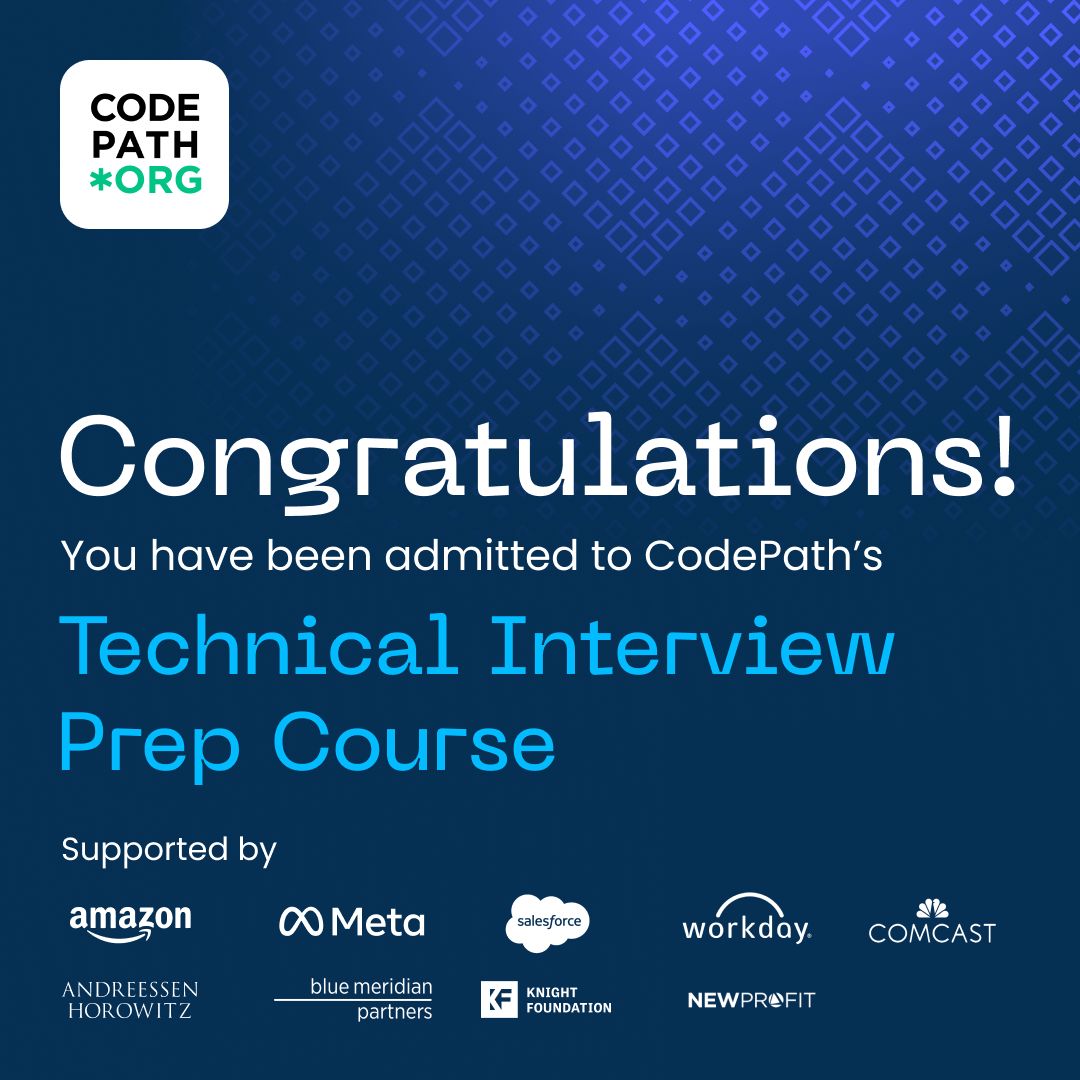
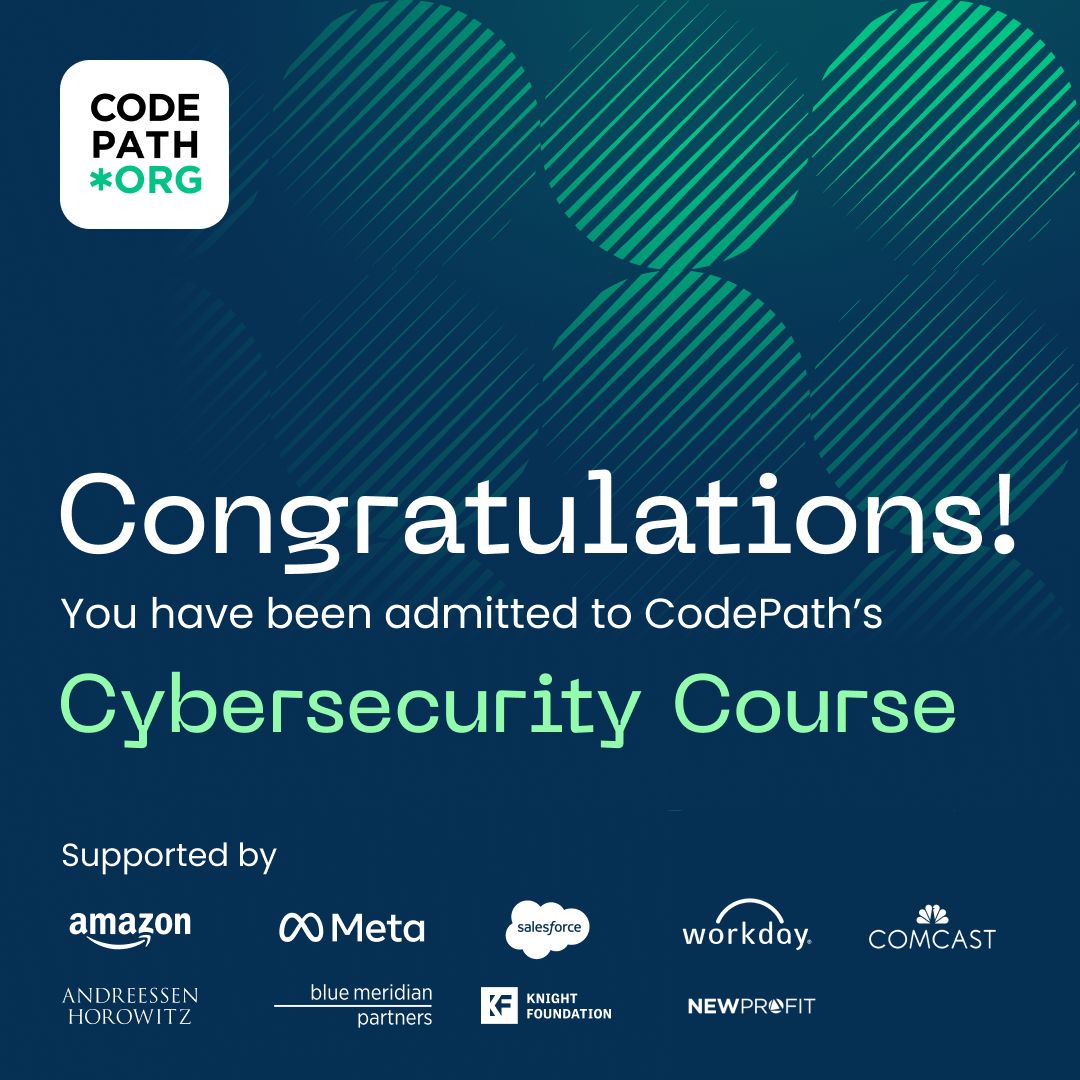
Admission Celebration Graphics
Course-specific designs provided to admitted students for social sharing. Each graphic reinforced sponsor visibility (Amazon, Meta, Salesforce, Workday) while giving students shareable content that signaled achievement to their networks.
Platform-Specific Content
Content was adapted for each platform’s native format and audience behavior — not cross-posted identically. TikTok content used the carousel format to match how students consume content on that platform: swipeable, visual-first, with minimal text overlay. The example below shows a HackerRank prework completion nudge — a mid-funnel action step that lives between application and admission.

HackerRank prework nudge • Carousel format • Posted January 7, 2025
Print & Digital Collateral
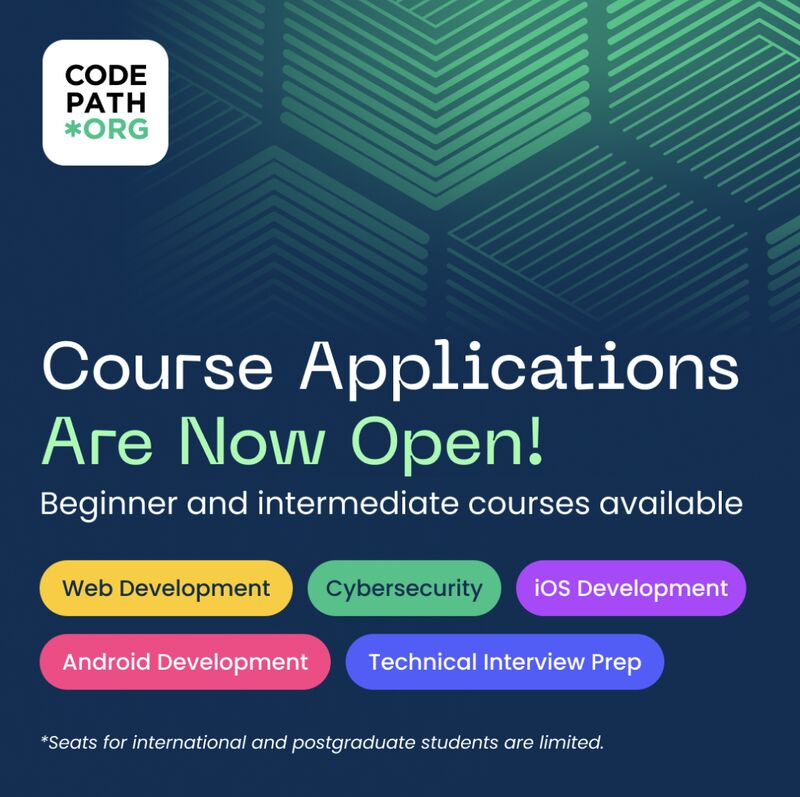
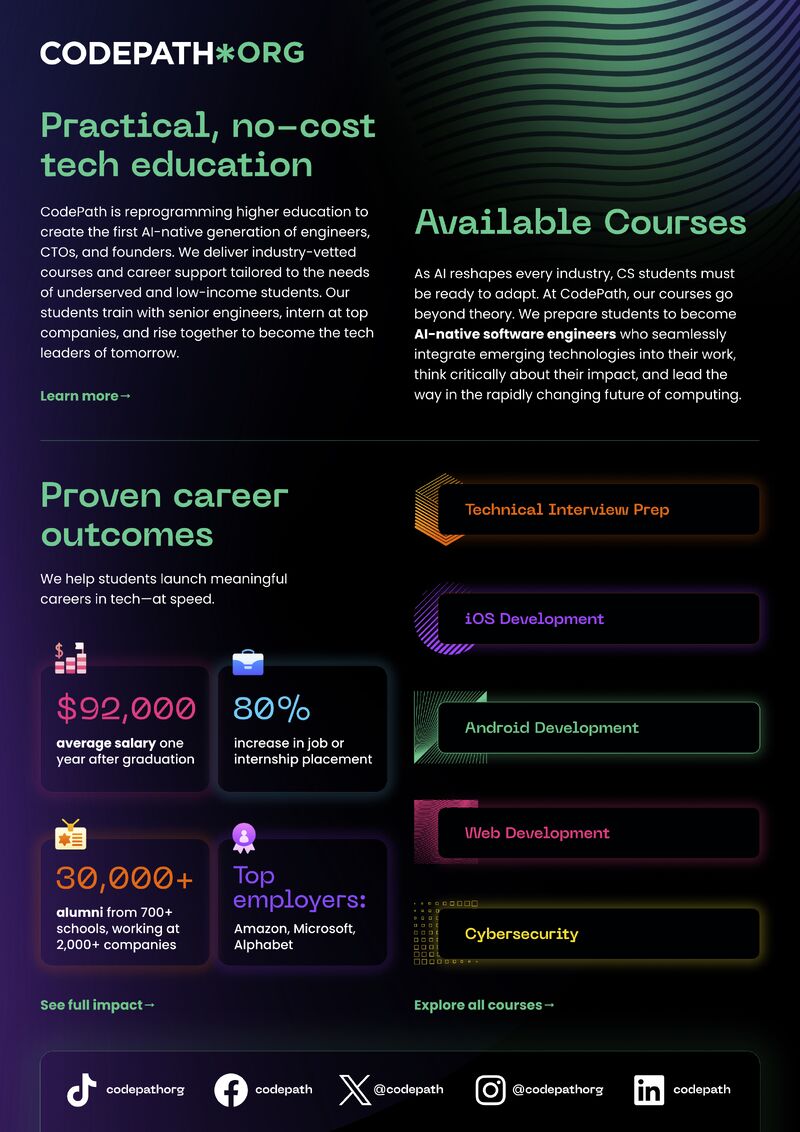
I revamped CodePath’s flyer design in Canva for use across email campaigns, campus events, and ambassador outreach. This included updating the visual identity, writing all copy, selecting and positioning outcome data, and producing print-ready and digital versions. For branded partner collateral (co-branded assets with Workday, AmazonNext), I led creative direction with the vendor design team to maintain brand consistency across both organizations.
Design Decisions
The flyer needed to work in three contexts: embedded in email campaigns, handed out at career fairs and campus events, and shared digitally by student ambassadors. Key design choices:
Outcome stats above the fold — $92K salary, 80% placement, 30K+ alumni. These are the numbers that convert a skeptical student browsing a career fair booth.
Course track pills — color-coded by track so students can immediately identify relevance. Scannability over density.
Sponsor logos prominent — Amazon, Meta, Salesforce, Workday. For students unfamiliar with CodePath, employer recognition does the credibility work that brand awareness can’t yet.
Attribution Architecture
Every touchpoint in the program was tagged with a consistent UTM framework I designed and implemented across all channels. I configured UTM parameters at the asset level in HubSpot, built campaign-level dashboards for cross-channel reporting, and managed the full asset library — organizing emails, landing pages, forms, workflows, and creative files within HubSpot’s campaign tools for team visibility and auditability.
Campaign contact lists were built with layered segmentation logic: university partner, course track interest, funnel stage, and engagement history. I created and maintained exclusion lists to suppress contacts who had already applied, been admitted, or opted out — protecting deliverability and brand trust. List hygiene was ongoing, not one-time.
UTM Structure Example:
utm_campaign = STUDENT – SP25 – ConnClass
utm_source = hs_email
utm_medium = email
utm_content = [unique email/asset ID]
This structure was applied consistently across all 12 emails, 12 SMS messages, blog links, social media posts, landing pages, and event registrations — enabling cross-channel attribution and campaign-level ROI reporting in HubSpot.
Tools & Platforms
The program ran across eight platforms, each handling a distinct operational layer. No agency, no freelancers — one person across all of them.
Results
These metrics compare Spring 2025 enrollment campaign performance to the prior year’s campaign for the same cohort cycle. The program I inherited had functional infrastructure but lacked strategic coherence — emails were sent, but there was no arc. Content existed, but it wasn’t integrated into the funnel. The improvements below came from imposing a strategic framework on existing channels, continuous A/B testing across subject lines, copy, creative, and send timing, and rigorous list hygiene — not from increasing spend.
The courses-per-student metric is the one I’m proudest of. It means the campaign didn’t just get people through the door — it set expectations accurately enough that students came back for more. That’s the difference between recruitment marketing and enrollment marketing: one fills a seat, the other builds a relationship.
What I’d Do Differently
If I ran this program again with the same resources, three things would change.
First, I’d build the ambassador program earlier. The organic student content — the admission celebration shares, the referral posts — outperformed anything we published from the brand account in terms of trust and conversion. I treated it as a complement to the email sequence. Next time it would be the backbone, with email and SMS supporting the peer-to-peer engine instead of the other way around.
Second, I’d push harder on SMS as a standalone channel rather than mirroring email cadence. Students read texts. The SMS open rates confirmed that. But the content was too similar to the emails — it should have been shorter, more conversational, and timed differently. Text is an interruption medium. Email is a consideration medium. They deserve different copy.
Third, I’d instrument the full funnel for cohort analysis — not just campaign-level attribution but segment-level: which university partners converted at what rate, which course tracks had the longest consideration windows, which funnel stage lost the most prospects. The UTM architecture I built could support this. The reporting layer I had time to build couldn’t.
The best campaigns teach you what the next campaign should be. This one taught me that the most valuable marketing asset an organization has isn’t its email list or its ad budget — it’s students who’ve already said yes, telling their peers why.